
Oliver Knox, Chris Teague, Hannah Hartnett, Mick Bange, Kavina Dayal and James Quinn
Planting can be a complicated operation with numerous decisions to make and many factors determining the success of the resulting crop’s establishment. Establishment is a result of correct seed placement within well-formed beds allowing optimal seed-soil contact, sufficient but not excessive temperatures and moisture levels, vigourous seed and the absence of biotic threats (e.g. disease and insects) and physical barriers (e.g. surface crusting). In practice, it is unrealistic to expect perfect sowing conditions. The range of contributing factors need to be balanced to ensure success. But have you ever wondered about the relative influence of each of these factors? We did, and we turned to a computer to help us assess this and challenge our beliefs.
Cotton Seed Distributors (CSD) strives to deliver quality seed and services to ensure the best success for the Australian cotton grower, but we know it is hard to accurately predict the likelihood of getting a seedling to establish based solely on seed quality information. So, to better understand what factors influence establishment and to what extent/degree these factors influence outcomes we analysed Variety Trial and Ambassador Network datasets (stored in CSD’s Extension Research Information Collection Application (ERICA)) with machine learning.
Our goals were to:
- Gain insights into establishment using a large dataset and machine learning. Machine learning enables dataset analyses without any preconceived bias on how factors influence the outcomes being assessed.
- Determine the main influences and the degree to which they affect final establishment.
- Identify possible interactions affecting seed emergence, to try and better understand why things happen in the field the way they do.
Our analysis overview:
- Nine years of crop establishment data (2016-2024).
- 1261 cotton crops spread throughout the entire industry.
- 40 independent measured factors related to cotton establishment.
The machine learning approach is unbiased, it simply analyses the data it receives and attempts to predict outcomes accordingly. For more detail on machine learning see Dr Alison McCarthy’s article on ‘Artificial Intelligence: what is it and what does it mean for cotton’ in the Feb-March 2024 Cottongrower. With respect to this analysis, it is worth noting that the biotic and physical barriers (e.g. disease load, insect pressure, residual herbicide and surface crusting) known to influence establishment weren’t available for inclusion in the analysis.
The initial analysis showed that 12 factors were significant in explaining establishment across all the data. These twelve factors represent seed quality attributes, temperature (climatic and soil) influences on seed development and agronomic practices that affect imbibition and emergence of the seed. The influence of each variable on establishment was reported as a percentage, reflecting both the influence of that variable on the final establishment and its interaction with other factors (Figure 1).
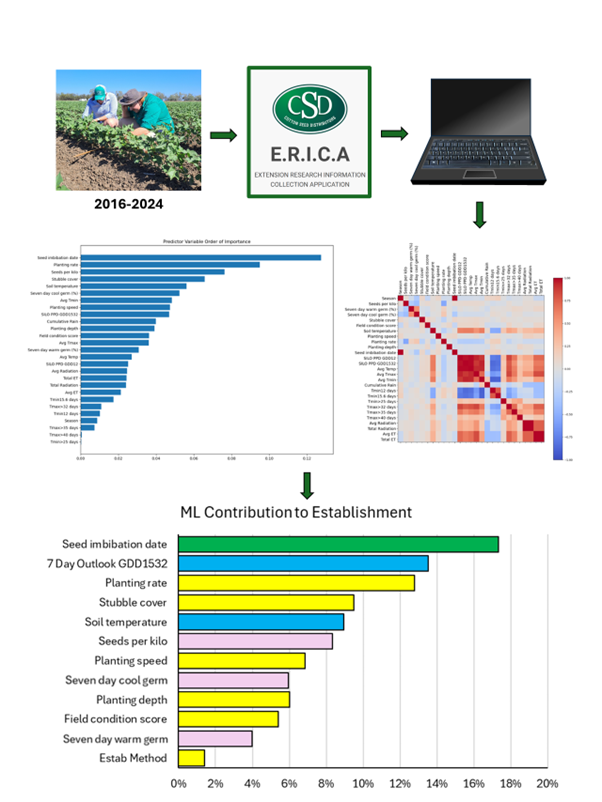
Figure 1 A schematic of the process followed to capture the establishment data, store it (ERICA), analyse it with machine learning and presenting the nature of the outputs and subsequent associations.
This interaction is important because these factors do not stand in isolation. In our farming operations, one variable may fall short, but can often be compensated by others.
For example, seed lots of varying density and vigour characteristics may show significant differences under cool conditions, but no significant difference under warm conditions, regardless of the seed’s characteristics.
Machine learning findings:
What the machine learning reported was that the planting date, at 17%, had the highest influence of all 12 main factors on affecting establishment. Planting date is a key agronomic decision that also has obvious links to the temperature effects on establishment.
In attempting to illustrate the machine learning analysis we developed the establishment triangle (Figure 2), where the three sides represent seed quality, temperature, and agronomic conditions all adding to the whole triangle. Ideally, all three sides would be perfect, but this is often impractical in farming. If one aspect of the triangle is not ideal, which is often the case when making our planting decisions, then the other sides need to compensate to achieve establishment. However, whilst cotton is an incredible plant, even cotton has limitations that can’t always be overcome, no matter how ideal the other aspects of our systems might be. For example, one can have the perfect seed bed, but if temperatures are too low no seed is going to survive, thrive and emerge to deliver a plant stand.
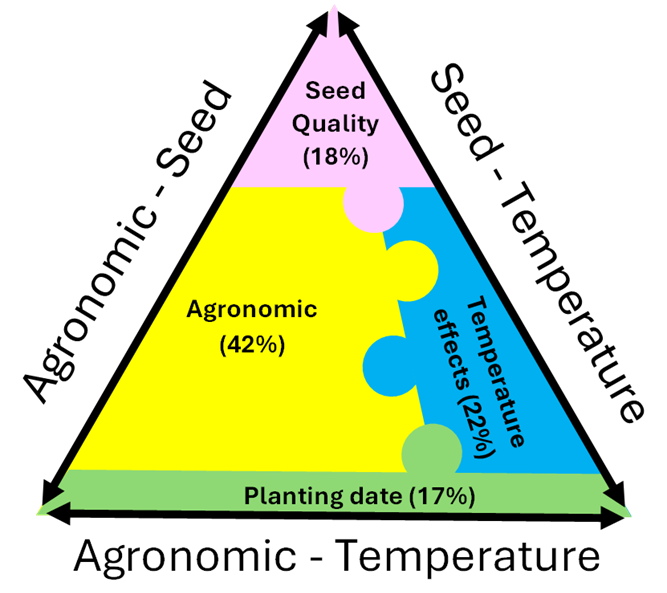
Figure 2 An establishment triangle, developed from computer predictions of the contributing factors to cotton establishment that was derived from the 12 main parameters of a nine year dataset. Factors were grouped to give three main parameters; seed quality, agronomic and temperature effects, with planting date being a separate variable associated with both agronomy and temperature.
This analysis might not have taught us anything strictly new, but it does help to confirm and remind us that cotton establishment is the outcome of numerous factors that we cannot look at in isolation. It is how these factors work together that delivers a successfully established crop. In that regard, there is no strict recipe. Again, as an example we can have high quality seed planted into a perfect seedbed, but if it is cold then we will get a poor establishment regardless. Conversely, we can plant lower vigour seed into hard setting soil with high stubble loads, but if the temperatures are high, we can achieve establishment.
The key messages from this analysis are:
- Many things contribute to successful final establishment.
- The data available could be grouped into 3 categories and highlighted that establishment is not reliant on just one category.
- If some factors are below par, then others need to compensate to ensure establishment.
- Given the significance of agronomic factors (42%), for good establishment ensure the field is prepared well, the planter is set up correctly and you are planting into an optimal environment.
- Planting date was the single most influential variable for establishment, directly linked to agronomy and temperatures. So, use the FastStart soil temperature network and CSD Traffic light for guidance on suitable planting conditions for emergence.