Field tested. Proven performance. Trusted to deliver.
The cotton industry is evolving – climate, market demand, management processes and technology advancements necessitate Australian growers and CSD to remain on the front foot, growing a high-quality product that’s sought after, sustainable and profitable.
That’s why we’ve invested in developing new varieties, built for the conditions you face. The Try Before You Buy trials arm you with local variety performance data and insights to help inform your on-farm decision making and plant new seed varieties with confidence.
2026 Season | Darling Down | Trial No. 2026049
Sicot 748B3F & Sicot 743B3XF Try Before You Buy
‘Uralla’, Macalister, QLD
Key takeaway
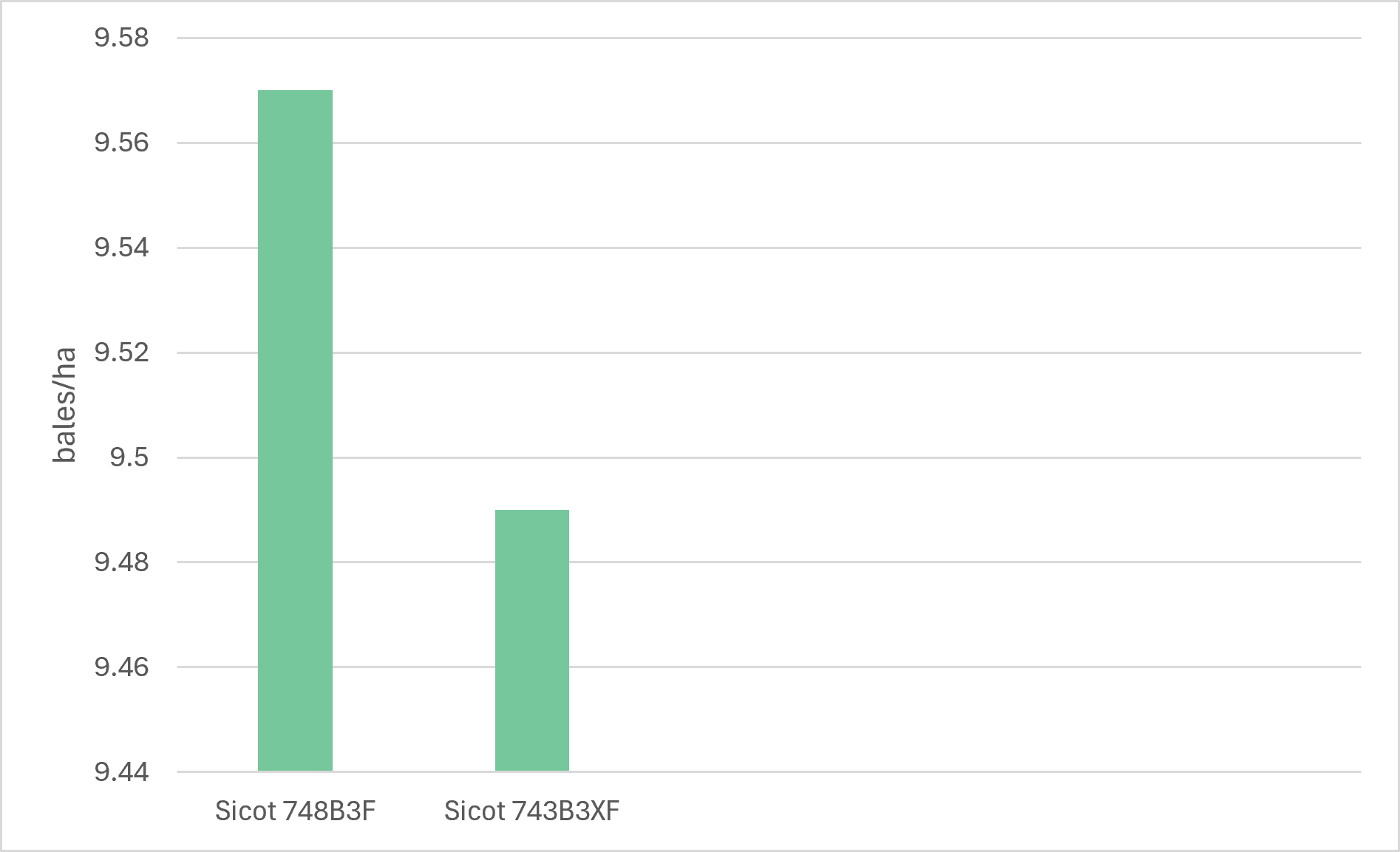
There was no significant differences in crop growth and yield of Sicot 743B3XF and Sicot 748B3F in this trial.
Management of Sicot 743B3XF and Sicot 748B3F is generally comparable due to their similar levels of indeterminacy.
System
Semi-irrigated
60 inch
Rainfall
383mm
4 irrigations
Top yield
9.57 b/ha
Sicot 748B3F
Trial snapshot
| Trial No. | 2026049 |
| Planting date | 5 November 2025 |
| Picking date | 28 April 2026 |
| Previous crop | Long fallow sorghum |
| Varieties | Sicot 748B3F and Sicot 743B3XF |
Season & field summary
The trial was planted into good field conditions following long fallow sorghum on 60 inch row configuration. The field was pre irrigated before planting and had four total in crop irrigations at 4ML/ha and in crop rainfall over the season totalled 497mm.
Early in the season, Sicot 743B3XF stood out with a better establishment with a consistent stand of 10-12 plants per metre, while the Sicot 748B3F was generally 9-10 plants per metre. The vigour of the Sicot 743B3XF was also notable early on in the seedling stage. The Sicot 743B3XF switched to reproductive growth sooner than the Sicot 748B3F and was generally more consistent in holding fruit early on. The Sicot 748B3F continued to switch between vegetative and reproductive nodes for a week or so, this meant the Sicot 743B3XF accumulated more bolls earlier in the season. The Sicot 748B3F grew more vigorously as the season went on and was slightly taller. Both varieties retained first position fruit well but struggled to hold second position squares at times. At the start of February, both varieties had a primary retention of 95%, while cumulated primary and secondary retention was back to 75%.
Management throughout the season was kept the same between the two varieties. At the end of the season, yield was very similar between the two. This matched what I found with boll counts at the end of the season.
Going forward, Sicot 743B3XF may be added into the regular list of varieties grown on this farm, to replace the previous mainstay of Sicot 748B3F. In the last two years, however, both Siokra 253B3XF and Sicot 761B3XF have performed very well and are likely to be grown in the largest amounts.
Trial results
Commercial results are from Olam Queensland Cotton, Dalby.
Yield & fibre quality comparison
| Variety | Yield | Staple length (imp) | Strength (g/tex) | Micronaire | Lint turnout (%) |
| Sicot 748B3F | 9.57 | 1.18 | 32.9 | 4.5 | 39.5 |
| Sicot 743B3XF | 9.49 | 1.22 | 33.4 | 4.8 | 40.5 |