Field tested. Proven performance. Trusted to deliver.
The cotton industry is evolving – climate, market demand, management processes and technology advancements necessitate Australian growers and CSD to remain on the front foot, growing a high-quality product that’s sought after, sustainable and profitable.
That’s why we’ve invested in developing new varieties, built for the conditions you face. The Try Before You Buy trials arm you with local variety performance data and insights to help inform your on-farm decision making and plant new seed varieties with confidence.
2026 Season | Darling Downs | Trial No. 2026048
Sicot 748B3F & Sicot 743B3XF Try Before You Buy
‘Milla-Lee’, Bowenville, QLD
Key takeaway
- Sicot 743B3XF performs well under overhead irrigation systems.
- Above average Day Degrees favoured both indeterminate varieties, Sicot 748B3XF and Sicot 743B3XF.
- Late rainfall allowed Sicot 743B3XF to get ahead due to slightly later maturity.
System
Irrigated
Solid 1m
Rainfall
354mm
15 irrigations
Top yield
17.19b/ha
Sicot 743B3XF
Trial snapshot
| Trial No. | 2026048 |
| Planting date | 17 October 2025 |
| Picking date | 4 May 2026 |
| Previous crop | Long fallow cotton |
| Varieties | Sicot 748B3F & Sicot 743B3XF |
Season & field summary
The crop was planted into good conditions following long fallow cotton and watered up. Establishment was above 80% across both varieties. The crop suffered a small hailstorm in late October but there was not much observed damage.

Terry and Dan Ryan, ‘Milla-Lee’, Bowenville
The Sicot 743B3XF had lower early season vigour compared to Sicot 748B3F. No visually significant differences in establishment or early growth were observed. The main stressor during the season was moisture availability, driven by below-average rainfall and limited irrigation water. By late February, the crop was approaching moisture deficit conditions but fortunately received rainfall that supported the finish of the season. This late rainfall would likely have provided a greater benefit to Sicot 743B3XF than Sicot 748B3F due to its slightly later maturity. Sicot 743B3XF is more compact than the Sicot 748B3F and would likely need less growth regulant. Sicot 743B3XF is slower to mature, seems to have a longer season than Sicot 748B3F. For this reason, usually wouldn’t target this variety in these areas as season length can be an issue.
This season being slightly above average day degrees and nice finish probably favoured the longer variety in Sicot 743B3XF. Sicot 743B3XF achieved a significantly higher gin turnout, resulting in a lint yield of 17.19 bales/ha compared with 16.06 bales/ha for Sicot 748B3F. While the higher turnout was the primary driver of the yield advantage, some of the difference may also be attributed to the additional late-season fruit retained by Sicot 743B3XF. Based on the data currently available, I would not favour Sicot 743B3XF over Sicot 748B3F without further testing and experience. On this farm, I would be hesitant to adopt Sicot 743B3XF more broadly due to its greater reliance on a long season to realise its yield potential.
Trial results
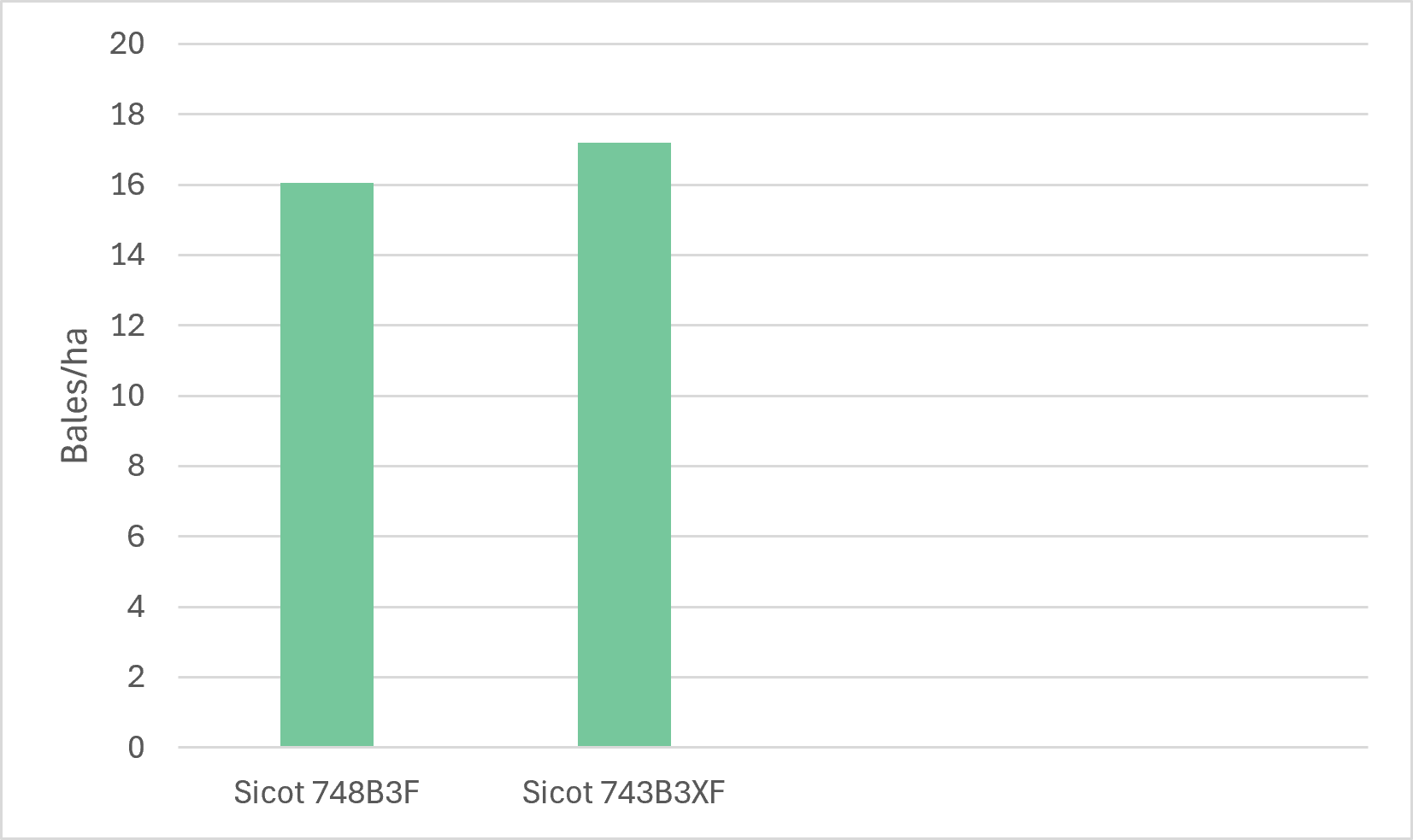
TBYB yield results from Terry Ryan, ‘Milla-Lee’, Bowenville. Results are from LDC gin, Dalby.
Yield & fibre quality comparison
| Variety | Yield | Staple length (imp) | Strength (g/tex) | Micronaire | Lint turnout (%) |
| Sicot 748B3F | 16.06 | 1.24 | 31.0 | 4.4 | 41.6 |
| Sicot 743B3XF | 17.19 | 1.24 | 31.0 | 4.5 | 45.9 |
Agronomy insights
Both varieties, Sicot 748B3F and Sicot 743B3XF behaved similarly throughout the season, both reaching first flower and cutout around the same time. Sicot 743B3XF seemed to put on later bolls finishing with around 10 bolls more per meter. The crop received five irrigations of 2.5Ml/ha but eventually fell into a deficit before rain in February. Overall the crop had four mirid sprays and recieved 30ml/ha of flowering mepiquat before cutout application.
Fit & management considerations
Although Sicot 748B3F and Sicot 743B3XF are both more indeterminant varieties, Sicot 743B3XF matured slightly later than Sicot 748B3F in this field. The later rain supported Sicot 743B3XF in its final fruit setting and it has been observed that Sicot 743B3XF performs well under overhead irrigation systems in a full season situation.