
Each season, we recognise outstanding results achieved by growers conducting on-farm trials of CSD varieties as part of our Crop Optimisation Program. These growers play a vital role in testing new approaches, varieties and management practices under real farming conditions, generating valuable insights that support continual improvement across the industry.
Below are three case studies from winners of the 2025 CSD Crop Awards.

Andrew Watson
Namoi
2025 Rob Newell Award, Dr Ian Rochester Award, Dr Greg Constable Award and Frank Hadley Award winner
The Watson family has been part of the Namoi Valley farming community since 1965, building a resilient mixed enterprise around Boggabri in northern New South Wales. Cotton became part of their business in 1980. By 1982 the family had joined the CSD trials program, beginning a long relationship that still guides variety placement and management decisions today.
Andrew Watson and his wife Heike continue this legacy on soils that range from heavy black clays to red gravel loams, growing both irrigated and dryland cotton alongside other crops and cattle. Their approach blends modern agronomy with ecological thinking, including the release of beneficial insects to support biological pest control. Trials remain their bridge between research and practice, helping convert seasonal insights into paddock decisions with confidence.
The good thing for us is we get to see the varieties early. We get to see them perform on our soil type and how we manage our cotton, and this helps us to influence our decisions for the season ahead.
Seeing new genetics on their own country means the Watsons can match variety strengths to specific paddocks and water regimes. In 2024/25, Sicot 619B3XF led their results in the irrigated variety trial, at 17.78 bales per hectare. Fibre metrics were solid across staple, micronaire, strength and turnout, reflecting disciplined nutrition, timely irrigation and responsive growth regulation.
Management is one piece of the story. You have got to trial different things to work out the best fit and how to get the best out of the varieties.
The family’s approach begins with building the crop well from the start. Most nitrogen is applied pre plant with in‑crop top‑ups to sustain even growth. On irrigated country, water is scheduled to crop demand, aiming to minimise stress at key growth stages. Mepiquat chloride is treated as a steering tool, with rates adjusted to plant behaviour and season, so that crop architecture remains balanced on both black clays and red gravels. Clean paddocks are maintained through the rotation with timely cultivation, double‑knock tactics and biological control. When it comes to protecting fibre quality, the Watsons place real emphasis on planting into warm soils and picking ahead of major rainfall. Each of these elements is informed by years of side‑by‑side comparisons in the trial program and by watching how varieties respond under real‑world conditions on their farm.
The value of cooperation is not only in data but in people. Andrew points to the connection with agronomists as one of the program’s great strengths.
By participating in the trials, we also get to have close contact with CSD agronomists and get the opportunity to hear firsthand from them their insights throughout the season and learn from them.
That two‑way conversation underpins confident decision‑making and keeps the Watsons close to emerging insights each season. It also reflects the spirit of the family’s involvement over four decades: open to innovation, committed to sharing and focused on continuous improvement.
Last season, Andrew’s attention to detail and consistency were recognised with four CSD Crop Awards linked to the variety trial program. The CSD Crop Awards celebrate growers who deliver strong agronomic and fibre outcomes in CSD trials, highlighting the ability to bring out the best in the genetics under test. It is a fitting acknowledgment of the discipline and curiosity that have long defined the Watsons’ approach.
From the first cotton plantings in 1980 to a forty‑year partnership in trials, the Watson family has helped shape how varieties are understood and managed in the Namoi Valley. Andrew and Heike carry that legacy forward, blending generational knowledge with evidence from their own paddocks. Their story shows how long‑term cooperation can lift confidence, sharpen decisions and strengthen results for the family farm and for the wider cotton community. So if you are ever wanting more information or insights, then all you have to do is reach out.
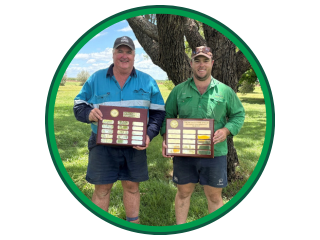
Terry and Dan Ryan
Darling Downs
2025 Peter Glennie Award and Dr Brian Hearn Award winner
Terry and Dan Ryan have participated in CSD trials for the past six years. The 2025 trial was planted into a field of long fallow corn stubble at the end of October, into a full moisture profile. It then had a quick flush with overhead sprinklers. Soil temperatures of 23°C and rising at planting set up great conditions for establishment. A final stand of 11 plants/m from 12 seeds/m dropped was achieved.
There was 385mm of rainfall recorded in-crop, most of which fell in March, which led to some boll rot.
End of season assessments were undertaken in mid-March and boll counts were good, with Siokra 253B3XF averaging 131 bolls/m, Sicot 761B3XF averaging 130 bolls/m, and Sicot 748B3F at 140bolls/m. The trial only required two defoliations before picking, with an excellent leaf drop and boll opening. Some rain fell between the two defoliations, which may have impacted the quality, although this has been very common across the region.
Picking went well, the Ryan’s had 25mm of rain just before the third defoliation. They were able to leave it for 10 days before they started to pick.
Crop summary
| Planting date | 5 October 2024 | |
| Establishment method | Rain Moisture | |
| Previous crop | LF Corn | |
| Field conditions score | 2 | |
| Row configuration | 1m | |
| Plant population | 12/m | |
| Establishment percentage | 94.2% | |
| Nitrogen (kg/ha) | Pre plant | 133 |
| Post plant | 92 | |
| Total | 225 | |
| Phosphorus (kg/ha) | 37 | |
| Potassium (kg/ha) | 56 | |
| Zinc (kg/ha) | 1.3 | |
| Rainfall (mm) | 385mm | |
| In-crop irrigations | 12 Lateral Irrigator. (Crop ETC 644) | |
| Soil applied insecticide | Nil | |
| Growth regulators | Flowering | 220ml |
| Cut out | 200ml | |
| Total | 420ml | |
| In-crop herbicides | 3 | |
| Days to defoliation | 169 |
Yield and quality results
|
|
Sicot 748B3F |
Sicot 761B3XF |
Siokra 253B3XF |
|
Yield (b/ha) |
16.64 |
15.01 |
13.77 |
|
Yield (b/ac) |
6.73 |
6.07 |
5.57 |
|
Staple (dec) |
1.21 |
1.22 |
1.17 |
|
Stable (imp) |
39 |
39 |
37 |
|
HVI class |
41-4 |
41-4 |
41-4 |
|
Micronaire |
4.0 |
3.9 |
3.5 |
|
Strength (g/tex) |
29.8 |
29.4 |
29.5 |
|
Turnout (%) |
44.0 |
45.0 |
46.0 |
|
Uniformity (%) |
81.5 |
82.0 |
81.0 |
Five tips for a top result
- Fallow into cotton – ‘1-in-1-out’ rotation produces highest yields.
- Soil test and ensure good levels of nutrition.
- Deep tillage and early seed bed prep to ensure even crop – no wheel compaction.
- Have enough water per Ha to ensure you don’t run out.
- Great timeliness to manage the crop for minimal stress – Moisture, weeds, insects, nutrition

Jack Strahley
Far North QLD
2025 Allan Brimblecombe Award and Eveleigh, Marshall & Kay Award winner
St Ronans runs a zero-till system with cotton in 100% rotation with maize on 30-inch rows. Weed pressure, especially fleabane during the wet season, is an ongoing challenge, so a pre-plant residual’s plus glyphosate applied.
The trial was planted into moisture on the 6 December 2024 following a maize crop. Due to 70% stubble cover, the planting rate was set to 12 seeds/m and planted at a depth of 3cm. The hot dry start in December through to mid-January afforded the crop to establish a good root season before the heavy rain events commenced in early February and March.
There was notable cotton seedling injury following emergence as a result of residual herbicides applied prior to planting which did reduce the overall plant stand population.
Clear skies, hot days, consistent but steady rainfall during December (225mm) allowed the cotton to get away to a great start. The less than average rainfall during January (82mm), resulting in vegetative growth heading into February. The average temperature from Planting to First Flower on 2nd February was 27.9°. The cotton had reached a metre in height and averaged 18 nodes by this stage but was holding onto 85% first position fruit by First Flower.
Sicot 619B3XF showed the highest potential yield at First Flower in the variety trial.
The use of Mepiquat certainly helped the cotton shift from a vegetative state to a reproductive state, however the use of earlier Mepiquat on the Sicot 619B3XF, potentially may have benefitted from higher rates earlier leading up to first flower to reduce the excessive vegetative growth and subsequent shedding leading into a very wet February and March.
As they rolled into February, so did the wet season, receiving 341mm during the month of February and 248mm during March. This period, the cotton shed a lot of lower fruit which is typical in the tropics with limited solar radiation and waterlogging stress. However, the monsoon weather normally declines by April and the remaining three months leading up to defoliation the crop only received another 117mm which allowed the cotton to compensate well to finish off nicely.
St Ronans have experienced high aphid populations and Cotton Bunchy Top (CBT) over the past few seasons, making CBT resistant cotton varieties critical. Siokra 253B3XF topped the variety trial for yield, followed closely by Sicot 761B3XF, both CBT-resistant.
Crop summary
| Planting date | 6 December 2024 | |
| Establishment method | Rain Moisture | |
| Previous crop | LF Maize | |
| Field conditions score | 3 | |
| Row configuration | 30 inch | |
| Plant population | 7.3/m | |
| Establishment percentage | 60.8% | |
| Nitrogen (kg/ha) | Pre plant | 54 |
| Post plant | 190 | |
| Total | 244 | |
| Phosphorus (kg/ha) | 15 | |
| Potassium (kg/ha) | 22.8 | |
| Zinc (kg/ha) | 0.7 | |
| Rainfall (mm) | 1015mm | |
| In-crop irrigations | Nil | |
| Soil applied insecticide | ||
| Growth regulators | Flowering | 150 |
| Cut out | 200 | |
| Total | 350ml/ha | |
| In-crop herbicides | 4 | |
| Days to defoliation | 201 |
Yield and quality results
| Sicot 619B3XF | Siokra 253B3XF | Sicot 761B3XF | Sicot 606B3F | |
| Yield (b/ha) | 8.62 | 9.89 | 9.53 | 6.91 |
| Yield (b/ac) | 3.48 | 4.04 | 3.85 | 2.79 |
| Staple (dec) | 1.21 | 1.17 | 1.23 | 1.23 |
| Stable (imp) | 39 | 37 | 39 | 39 |
| HVI class | 41-4 | 41-4 | 41-4 | 41-4 |
| Micronaire | 4.2 | 3.8 | 4.1 | 4.2 |
| Strength (g/tex) | 31.1 | 30.1 | 30.8 | 31.4 |
| Turnout (%) | 42 | 45.7 | 45.2 | 42.8 |
| Uniformity (%) | 82.6 | 81.6 | 83.4 | 82.1 |
Five tips for a top result
- Begin planting in early December, ensuring plant is well established before heavy rains in January and February.
- Rotation with Maize to control any ratoon cotton, creating a uniform plant line and combatting Gly resistant weeds.
- Growing a compact, less vegetative plant that will not be as susceptible to boll rot in drizzling rain at boll opening.
- Utilisation of previous corn crop stubble in a zero till system, thus creating heavy ground cover that retains crop finishing moisture when wet season ends.
- Farm an area where 200mm downfalls are common = great plant establishment.