
Field tested. Proven performance. Trusted to deliver.
The cotton industry is evolving – climate, market demand, management processes and technology advancements necessitate Australian growers and CSD to remain on the front foot, growing a high-quality product that’s sought after, sustainable and profitable.
That’s why we’ve invested in developing new varieties, built for the conditions you face. The Try Before You Buy trials arm you with local variety performance data and insights to help inform your on-farm decision making and plant new seed varieties with confidence.
2026 Season | Darling Down | Trial No. 202679
Siokra 253B3XF & Sicot 761B3XF Try Before You Buy
‘Troynes’, Kupunn QLD
Key takeaway
A dry season that showed its good to see varieties under different conditions when grown in dryland systems
Siokra 253B3XF was much more determinate this season than last and was quick to fruit up but also cut out based on seasonal conditions.
System
Dryland
Double skip
Rainfall
140mm
Top yield
5.28 b/ha
Siokra 253B3XF
Trial snapshot
| Trial No. | 202679 |
| Planting date | 16 October 2025 |
| Picking date | 5 April 2026 |
| Previous crop | Long fallow sorghum |
| Varieties | Siokra 253B3XF & Sicot 761B3XF |
Season & field summary
The trial was planted in mid-October following a long-fallow sorghum crop, achieving an establishmentof approximately 5 to 7 plants per metre. While the crop experienced several periods of heat stress, temperatures remained below 40°C, which was fortunate given it received only 140 mm of in-crop rainfall. Despite these challenging conditions, the crop produced just over 5 bales per hectare, although fibre quality reflected the environmental stress encountered throughout the season.

The way the varieties performed this year under the conditions they had was great and was happy with the results. There was good field preparation before planting, with excellent stubble cover that allowed us to take advantage of a smaller rain event of about 20mm to get seed into the ground. It was a mild year in terms of temperature, but rain was spare. The crop did everything it could with the little rain it did have and on paper it did have 140mm for the season a good share fell post cut out and wasn’t effective. Getting over 5 bales therefore was a great result.
Trial results
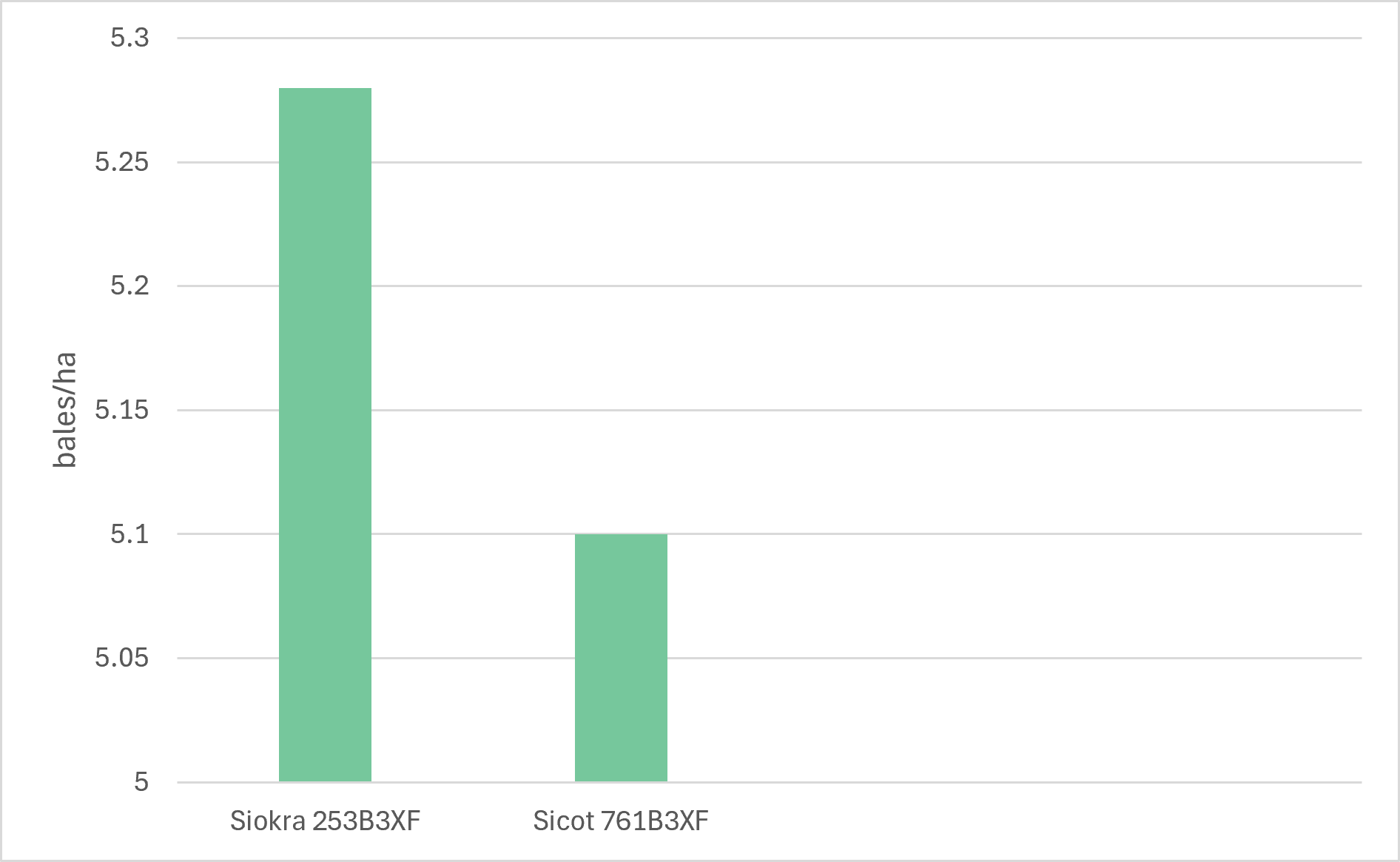
TBYB yield results from Dan Hayllor, ‘Troynes’, Kupunn. Results are from LDC Gin, Dalby
Yield & fibre quality comparison
| Variety | Yield | Staple length (imp) | Strength (g/tex) | Micronaire | Lint turnout (%) |
| Siokra 253B3XF | 5.28 | 1.10 | 30.4 | 4.0 | 44.7 |
| Sicot 761B3XF | 5.10 | 1.12 | 32.1 | 4.5 | 44.8 |
Agronomy insights
The trial demonstrated the crop’s ability to perform under limited moisture conditions with just over 140mm and around a portion of it was the month before defoliation so was not very effective to the crop. The trial battled its way though the season and did a great job getting over 5 bales considering the conditions. The Siokra 253B3XF seemed to differ in its growth pattern this season when compared to last years. Likely influenced by the hotter season it seemed to keep in height more in check and favoured a rapid accumulation of bolls often cutting out ahead of other varieties when in the same field. The Sicot 761B3XF grew similar this year in a dry season as it did last year in a wetter season suggesting it is moderate in the face of both adversity but also an average season.
Fit & management considerations
The Siokra 253B3XF and Sicot 761B3XF have done well in dryland trials in wet season so it was good to test the varieties in a year that wasn’t so kind. The lower staple in the Siokra 253B3XF compared to other varieties was seen in other trials though so was the lower micronaire. A naturally lower micronaire can be a benefit when the temperatures start to climb so its still can have a place on farm. The Sicot 761B3XF has shown good quality especially in strength though does shows a naturally higher micronaire. The Siokra 253B3XF was happy to rapidly accumulate bolls and had a quick flowering period not getting to the height it had last year.