
Each season, we recognise outstanding results achieved by growers conducting on-farm trials of CSD varieties as part of our Crop Optimisation Program. These growers play a vital role in testing new approaches, varieties and management practices under real farming conditions, generating valuable insights that support continual improvement across the industry.
Below are two case studies from winners of the 2025 CSD Crop Awards.
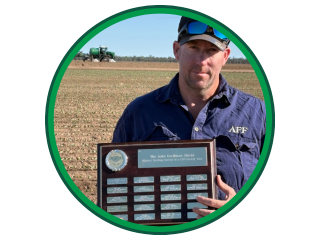
Jon Carter
Western NSW
2025 John Grellman Award winner
With 21 years growing cotton across Moree, Burren Junction and Bourke – and more than a decade as a CSD trial co-operator – Jon Carter credits consistent performance to getting the basics right.
Ahead of planting, fields were deep ripped on an angle, fertilised and formed into beds. Weed control was managed through winter fallows and post-emergence. Soil testing guided nutrition, with pre-plant urea and in-crop nitrogen (side-dressed anhydrous ammonia), plus phosphorus, potassium and zinc applied up front.
The seed was planted on 30 September 2024 at a soil temperature of 18.4°C, then watered up three days later. A FastStart weather station supported decision-making. The result was a strong, uniform stand -10.2 plants per metre or ~80% establishment.
Variety selection was driven by performance. On-farm trials conducted with CSD provides direct insight into which new varieties were worth adopting, with yield remaining the key benchmark.
The crop benefited from favourable early conditions, with minimal stress during establishment. Seed treatments were used to manage early-season insect and disease pressure, while fertiliser applied during the fallow period and in-crop supported steady growth.
Graphite was added at planting to ensure smooth seed flow, further contributing to even establishment.
Across the season, the crop received 12 in-field irrigations, with a total of 9.8 ML applied, complemented by 150 mm of rainfall. Timing each irrigation to suit soil conditions proved critical in maintaining crop momentum and optimising water use.
For Jon, achieving a top result isn’t about chasing silver bullets. It’s about discipline – executing the basics well, using data to guide decisions, and staying open to improvement.
Five tips for a top result
- Strong ground preparation
- Good-quality water (tested)
- Even plant establishment
- Close collaboration with advisors
- Well-timed irrigation based on soil type
Crop summary
| Planting date | 30 September 2024 | |
| Establishment method | Water up | |
| Previous crop | LF Cotton | |
| Field conditions score | 3 | |
| Row configuration | 1m | |
| Plant population | 10.2/m | |
| Establishment percentage | 78% | |
| Nitrogen (kg/ha) | Pre plant | 120 |
| Post plant | 260 | |
| Total | 380 | |
| Phosphorus (kg/ha) | 40 | |
| Potassium (kg/ha) | 40 | |
| Zinc (kg/ha) | 2 | |
| Rainfall (mm) | 150mm | |
| In-crop irrigations | 12 | |
| Soil applied insecticide | ||
| Growth regulators | Flowering | 50ml |
| Cut out | 100ml | |
| Total | 150ml | |
| In-crop herbicides | 2 | |
| Days to defoliation | 169 |
Yield and quality results
| Siokra 253B3XF | Sicot 761 B3XF | Sicot 743 B3XF | CSX 1257 B3XF | |
| Yield (b/ha) | 17.08 | 16.31 | 16.49 | 18.43 |
| Yield (b/ac) | 6.91 | 6.60 | 6.67 | 7.46 |
| Staple (dec) | 1.21 | 1.27 | 1.20 | 1.25 |
| Stable (imp) | 39 | 41 | 38 | 40 |
| HVI class | 51-5 | 51-4 | 51-4 | 51-4 |
| Micronaire | 4.2 | 4.6 | 4.5 | 4.5 |
| Strength (g/tex) | 31.2 | 32.4 | 30.3 | 31.5 |
| Turnout (%) | 41 | 40.5 | 42 | 43 |
| Uniformity (%) | 82.4 | 84 | 81.3 | 81.5 |

Jason Salvetti
Far North QLD
2025 Norm Thomson Award winner
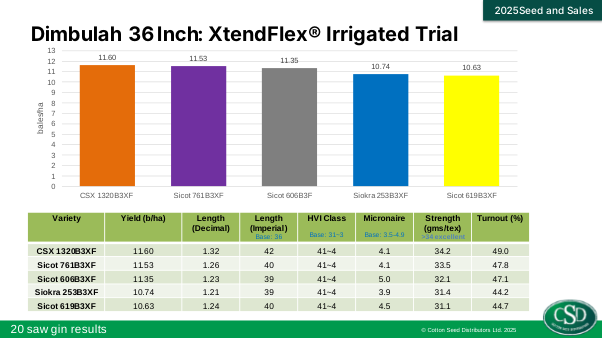
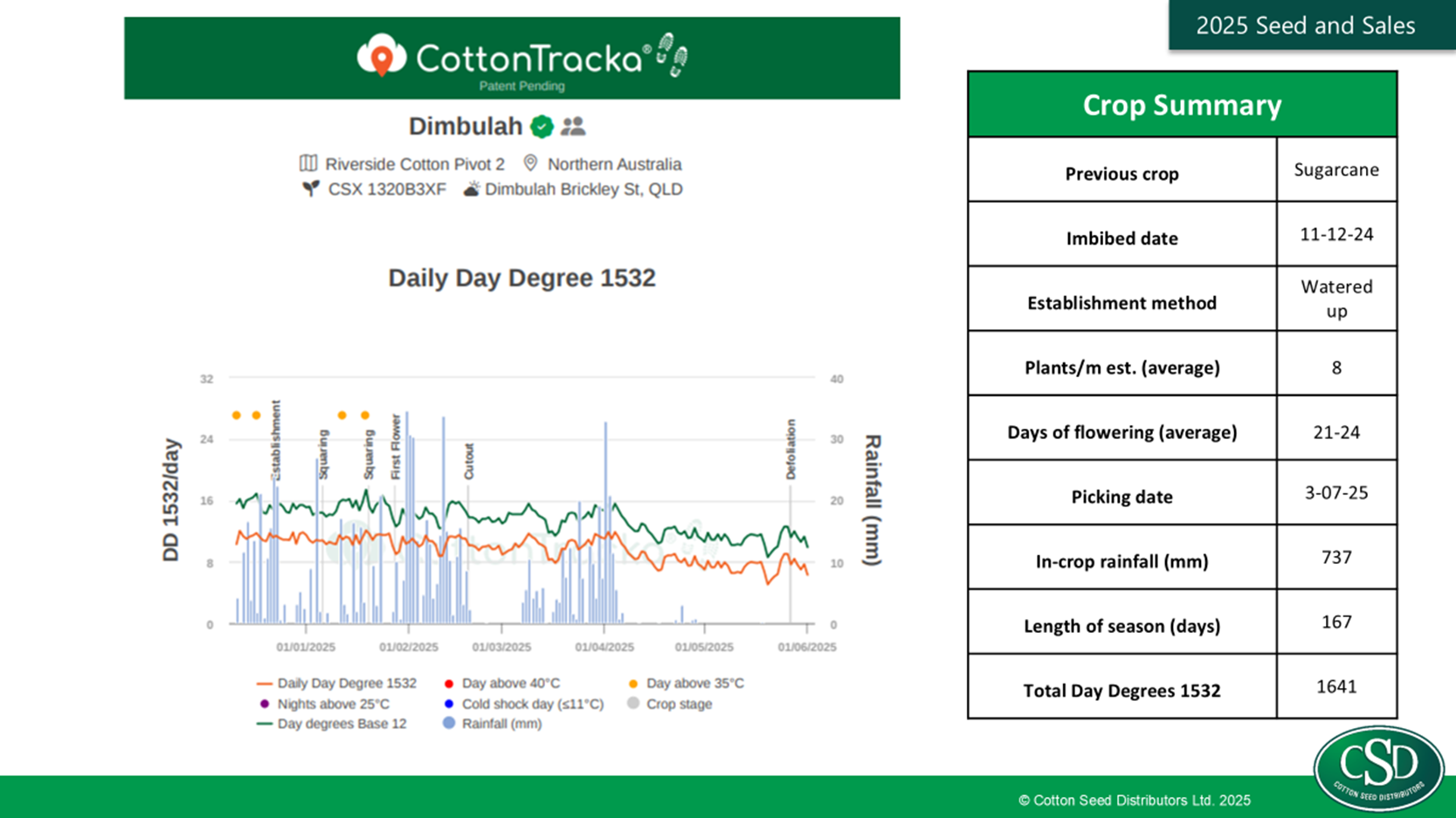
Sicot 619B3XF, Siokra 253B3XF, Sicot 716B3XF, Sicot 606B3F and CSX 1320B3XF varieties were planted and watered up by overhead irrigation on 11 December 2024 under hot, dry conditions, which supported strong early establishment.
By 30 January 2025, CSX 1320B3XF demonstrated excellent early growth, averaging:
- Height: 73 cm
- Squaring Nodes: 10.2 (15.3 total nodes)
- Nodes Above White Flower: 9.3
- First-Position Fruit Retention: 99%
The crop continued to progress well through February and March, averaging 150+ bolls/m by the end of March. However, late March and early April brought cooler nights and reduced heat units, causing a shedding event that lowered boll counts to 145 bolls/m by late April. Despite this setback and earlier boll rot, the crop rebounded strongly, reaching 163 bolls/m, 22 nodes, and 115 cm height by 2 July 2025, just prior to harvest.
Mepiquat was applied on 7 May 2025 to control continued vegetative growth driven by late fertiliser top-up and warm conditions. Defoliation began on 27 May 2025 but was complicated by cold nights causing leaf freezing and a 25 mm rain event mid-defoliation, requiring three applications before harvest.
Following a total of 737mm of rainfall for the growing season, picking commenced on 3 July 2025 and proceeded well despite defoliation challenges. These issues caused minor trash and colour concerns, reflected in an average HVI Class of 41~4. Nevertheless, yields exceeded previous seasons, and fibre quality was outstanding:
- Yield: 11.60 b/ha
- Staple Length: 42
- Strength: 34.2 g/tex
CSX 1320B3XF topped performance metrics, providing strong confidence in future experimental varieties
Crop summary
| Planting date | 5 October 2024 | |
| Establishment method | Rain Moisture | |
| Previous crop | LF Corn | |
| Field conditions score | 2 | |
| Row configuration | 1m | |
| Plant population | 12/m | |
| Establishment percentage | 94.2% | |
| Nitrogen (kg/ha) | Pre plant | 133 |
| Post plant | 92 | |
| Total | 225 | |
| Phosphorus (kg/ha) | 37 | |
| Potassium (kg/ha) | 56 | |
| Zinc (kg/ha) | 1.3 | |
| Rainfall (mm) | 385mm | |
| In-crop irrigations | 12 Lateral Irrigator. (Crop ETC 644) | |
| Soil applied insecticide | Nil | |
| Growth regulators | Flowering | 220ml |
| Cut out | 200ml | |
| Total | 420ml | |
| In-crop herbicides | 3 | |
| Days to defoliation | 169 |
Yield and quality results
| Sicot 748B3F | Sicot 761B3XF | Siokra 253B3XF | |
| Yield (b/ha) | 16.64 | 15.01 | 13.77 |
| Yield (b/ac) | 6.73 | 6.07 | 5.57 |
| Staple (dec) | 1.21 | 1.22 | 1.17 |
| Stable (imp) | 39 | 39 | 37 |
| HVI class | 41-4 | 41-4 | 41-4 |
| Micronaire | 4.0 | 3.9 | 3.5 |
| Strength (g/tex) | 29.8 | 29.4 | 29.5 |
| Turnout (%) | 44.0 | 45.0 | 46.0 |
| Uniformity (%) | 81.5 | 82.0 | 81.0 |
Five tips for a top result
- Managing Nitrogen throughout the wet season to minimise loses to due prolonged wet season events.
- Sufficient potassium to minimise/eliminate early disease and senescing.
- Seed spacing. Maximum 9 seeds/m, minimising doubles to ensure consistent plant spacing.
- Planting early December to prevent germination and establishment during prolonged wet periods and declining day degrees at the end of the season.
- Vegetative growth management – Keeping varieties compact with mepiquat to help reduce disease and boll rot and assist with fruit retention. Anecdotal evidence suggests that varieties like Sicot 619B3XF yield significantly higher if they are kept under control by reducing vegetative growth.