
Comparison of Siokra 253B3XF with both Sicot 606B3F and Sicot 748B3F: An analysis of side-by-side trials
The 2024/25 season saw the commercial release of four varieties containing the Bollgard® 3 and XtendFlex® technology. There has been some discussion in the industry as to the need for these new varieties when the industry is serviced by such fantastic varieties such as Sicot 606B3F and Sicot 748B3F.
Sicot 606B3F is a top performing variety which was originally bred for growing conditions in Southern New South Wales. Initial uptake of this variety was slow, but after registering high yields across the CSD variety trial program it has settled at approximately 30% of the Australian cotton industry by seed volume.
Sicot 748B3F was released in 2015/16 season and is a versatile and adaptable variety that performs well both in irrigated and dryland production systems. The resilience of this variety to handle setbacks and recover quickly has made it a favourite amongst growers, especially in the dryland production system.
Why do we need to change?
The Australian cotton industry has been built on innovation and willingness to adopt new and better technology and varieties to push productivity and sustainability goals. The industry has been blessed with a relatively stable period of variety development with a ten-year period where the variety suite did not change. CSD understands that change after such a period of stability is hard, that’s why we have tried to be transparent with communication of our plans for the changeover period. Consequently, we instigated the Try Before You Buy Program to ensure all growers can discover for themselves the benefits of these new exciting variety offerings. Knowing that seeing it for yourself, under your own management and in your own fields will be the best way to provide confidence in the new varieties.
Cotton Breeding Australia, a history of delivering for the Australian cotton industry
The figure below of the CSD Variety Trial Program average yields show a gradual improvement over time. As a proxy for Australian cotton yields over time, we can extrapolate that yields have been improving by 0.163 of a bale every year. (Yield improved by a bale every 6 -7 years). Economically this represents an extra $95 in additional revenue per hectare each season for the Australian cotton grower. In the timeframe of this figure the Australian cotton industry has transitioned from conventional cotton through Ingard®, Round Up Ready®, Bollgard II, RoundUp Ready Flex® and Bollgard 3 and now transitioning to XtendFlex. These yield improvements have been achieved both by genetic improvement and improvements in management of the cotton systems assisted by the transgenic technologies listed above. As we strive for further gains in yield improvements, they are going to get more difficult to achieve through breeding alone as we get closer to the yield potential. Therefore, how these varieties interact with your fields, management and the seasonal conditions will contribute to the yields achieved year to year and going forward.
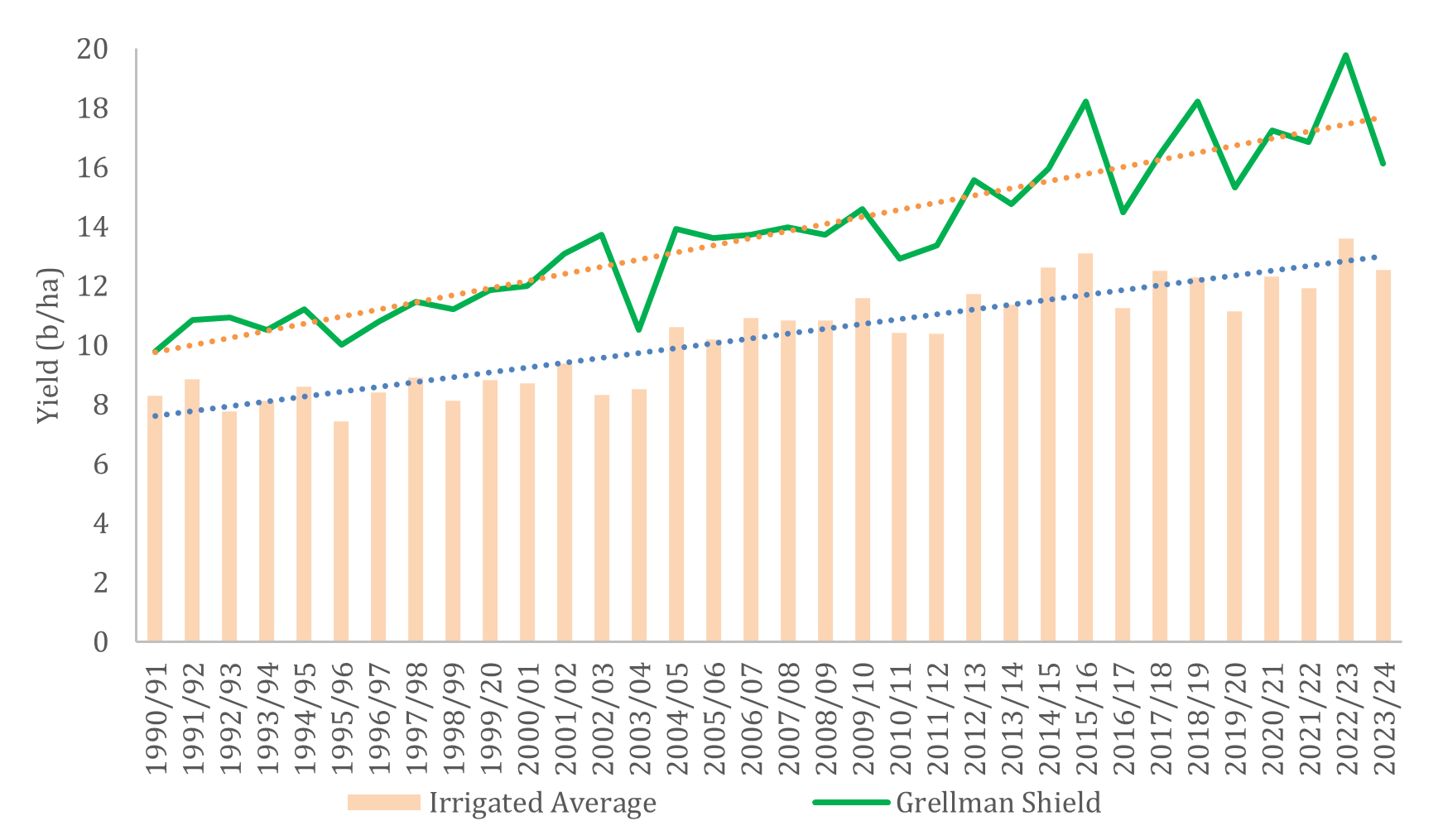
Figure 1: Timeline series of CSD Variety trial average yields from 1990 to present. The Grellman Shield is the award for the highest yielding irrigated variety trial yield.
CSD is endeavouring to be transparent and communicate openly about its plans to transition to the new suite of varieties containing XtendFlex. We understand change is hard and there may be many who are unsure of the potential of these newer varieties. CSD has full faith that these varieties can match varieties currently in the market, and deliver more regarding weed management flexibility, disease tolerance and improvements in fibre quality.
Inventory management is what seed companies are made or broken on, holding high-cost redundant stock in storage with the possibility of making a loss is not a great business strategy and as we want to keep the seed price as low as possible, so tight inventory management is required. We have stringent seed increase and quality procedures, which we are planning several years in advance to ensure we have enough seed to supply the Australian cotton industry. Procedures are in place and forecasting needs to be backed by reliable data and information.
In terms of breeding, this is a long-term process (10-15 years) – decisions are made within this lens. Additionally, XtendFlex is the platform which other traits will be brought to market under. Australia is currently lagging both the USA and Brazil in variety development with these new traits.
The breeding program transitioned to breeding solely for XtendFlex in 2016 and CSD has been discussing with industry the transition to varieties with XtendFlex for many years.
The yields of these new varieties have been variable
Yield is variable across a field, let alone a farm, valley or season. You do not expect that every field on your farm will yield the exact same if it has the same variety in it, or from year to year. That’s why at CSD we do side by side variety trials to test the varieties beside one and other under the same conditions and we try to eliminate in field variability as much as we possibly can, comparing apples with apples. Some regions in a particular year favour one variety over another, that’s why we like to look at the performance as a whole and over time. You can be confident that we have included all data for comparisons and if there are doubts, please visit the variety comparison tool on the CSD website. When undertaking comparisons of variety performance across all regions the amount of data should match closely with the data presented here.
In Figures 2 and 3 below we have done an analysis of all the direct side by side comparisons of Siokra 253BXF against Sicot 606B3F and Sicot 748B3F, the most popular varieties in Australia currently. In Figure 2 there are 32 direct comparisons covering both irrigated and dryland production systems. The plot is the result paired with a one-to-one line (orange dash). If a purple or green dot falls on this line, then the yields of both Siokra 253BXF and Sicot 606B3F are identical in the trial. Those above the dash line indicate Sicot 606B3F won and conversely those below the line Siokra 253 has won. As can be seen there is an equal distribution of those dots above and below the line. Interestingly, of the 13 trials conducted in the past season 7 were won by Siokra 253BXF.
To further add to this analysis, we have run a simple t Test on this data set to examine if there is a statistical difference between these varieties. The most important number to look at within the table is P(T<=t) two tail, this indicates whether there is any difference in the data and the probability that the difference happened by chance or not. This value is 0.808 which means there’s an 80.8% chance the difference you see is random noise, not a real difference in yield. We are looking for a P value of less than 0.05 to indicate a significant difference between these varieties.
So, from this analysis we can conclude, between Siokra 253BXF and Sicot 606B3F:
- Are the yields different? No
- Is the difference significant? Definitely not
- Should you treat these varieties as performing the same? Yes, based on this data
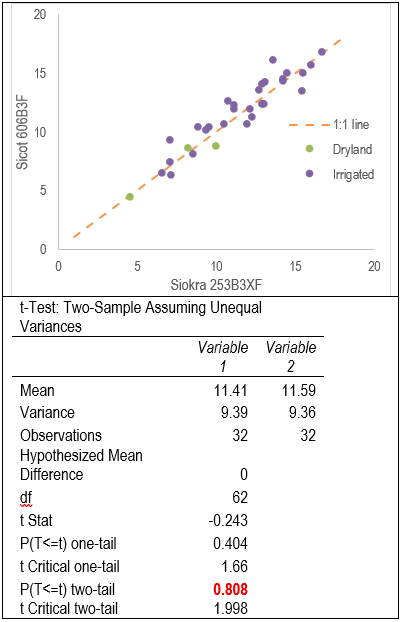
Figure 2: Direct comparisons between Siokra 253B3XF and Sicot 606B3F (29 Irrigated and 3 Dryland)
A similar analysis was performed on the 16 direct side by side comparisons of Siokra 253BXF and Sicot 748B3F. Siokra 253BXF has won 9 of the comparisons. In the table the P(T<=t) two tail number is 0.979 which means there’s a 97.9% chance the difference you see is random noise, not a real difference in yield.
So, from this analysis we can conclude, between Siokra 253BXF and Sicot 748B3F:
- Are the yields different? No
- Is the difference significant? Definitely not
- Should you treat these varieties as performing the same? Yes, based on this data
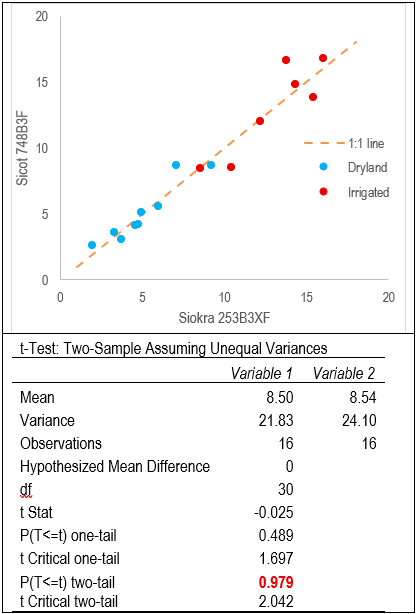
Figure 3: Direct comparisons between Siokra 253B3XF and Sicot 748B3F (7 Irrigated and 9 Dryland)
Do I need to manage the XtendFlex Varieties differently than the varieties I know?
The simple answer is well yes and no. In the comparisons here there was no differences in the management of these crops at a field level across all CSD variety trials, and similar management can deliver results. However, while growing cotton to a set recipe year-in-year may be convenient, but it is not how we extract the best from the variety. Each year is different, and no two crops or fields are the same, and although there are management practices (planting, spraying, irrigating, picking etc.) that need to be carried out, there are nuances depending on environmental variables, insect pressure and other external impacting forces. How you manage the crop is never the same either year in year out or in some cases from field to field. Management practices needed for these new varieties are not going to be anything that we have not experienced in the past. Following guiding principles and careful crop monitoring are going to enable the nuances of these new varieties to fit within your normal management regime.
The Okra Advantage
We have just seen there is no difference between the yield potential of these varieties, although all three have high yield potential, however, the Siokra 253BXF brings many other attributes as part of its varietal make up. Siokra 253BXF has the highest Verticillium ranking of all varieties offered by CSD currently. Therefore, if verticillium wilt is an issue in your fields, this variety will give the best defense against this disease. Additionally, as well as being fully resistant to Bacterial Blight, Siokra 253BXF is resistant to Cotton Bunchy Top.
The Okra leaf shape has many other advantages in opening the crop canopy for light interception, airflow and penetration of sprays to improve coverage of applications. Anecdotally, there were instances where many witnessed the quicker recovery from the wet weather this season, which has been attributed to better light and air circulation within this variety due to its leaf shape. Secondly the okra leaf is also unattractive to Mites and Silverleaf Whitefly, which do not like laying and habiting around the margins of cotton leaves, so they leave in search of more suitable hosts.
Siokra 253B3XF offers all the yield potential of its predecessors but offers additional benefits to some of the common challenges to Australian cotton production. If you’re still not convinced, then the only remaining solution is to try it for yourself.