
Once your cotton crop reaches cutout the focus shifts to nurturing until defoliation and harvest the bolls already set. At this stage, while the plant’s capacity for new fruiting sites is limited, there are still crucial management steps you can take to maximise yield potential.
Cutout to defoliation
Here’s SEVEN things to consider from cutout to defoliation.
1. Understanding and defining cutout
Cutout marks the end of the plant’s productive flowering stage, meaning no more new fruiting sites are being created. Ideally, an efficient crop has timed its physiological cutout with the Last Effective Flower (LEF)—the final flower expected to contribute to yield.
- Physiological cutout occurs when the plant reaches Nodes Above White Flower (NAWF) = 4 and declining before the latest possible location cutout date. This means a white flower appears within four nodes (and reducing) of the plant growing terminal.
- Last Effective Flower (LEF) is determined by end-of-season climate constraints. It represents the latest possible flowering date that allows for full boll maturation before defoliation and harvest. The LEF date also helps avoid cold conditions or wet weather that could impact crop quality.
For Southern New South Wales and closer to the Victorian Border, LEF dates typically fall between 10 and 15 February, this may be extended further into February under the new analysis below depending on location and seasonal conditions.
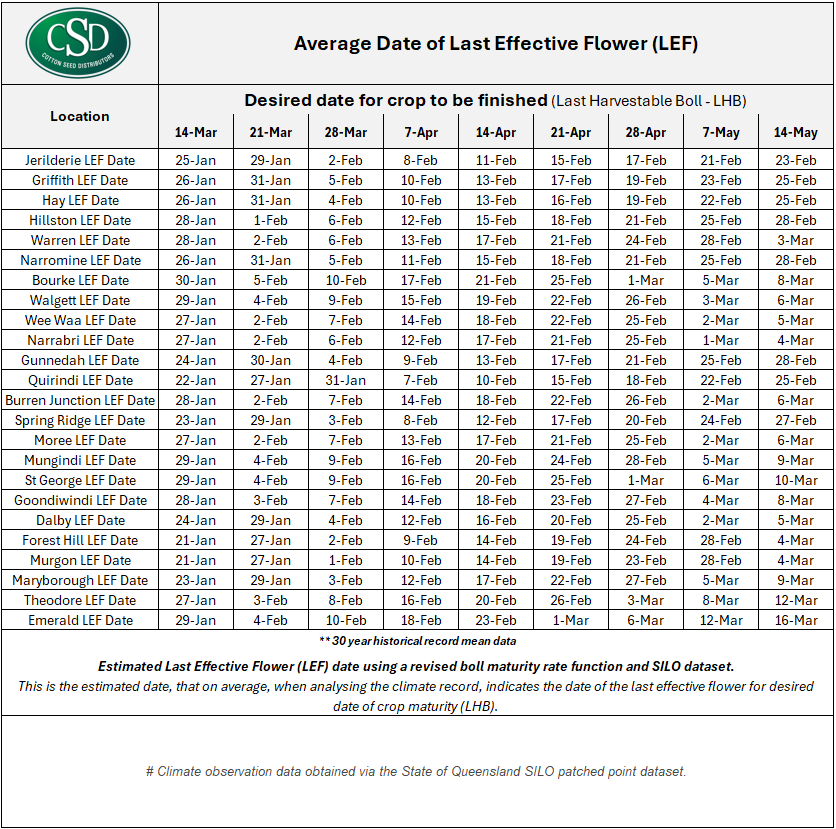
2. Day Degree Accumulation
Tracking day degrees (DD1532) from LEF to harvest is essential for timing defoliation. Recent research shows the accumulation required to mature a boll in the latter part of the season has been revised to 404 DD after LEF. This update accounts for fibre maturity rather than just boll opening, helping maximise both yield and fibre quality.
3.Timing Defoliation Correctly
Ideally, defoliation should occur when the last effective flower has matured into the last harvestable boll. Defoliation too early can lead to immature cotton fibres, reduced micronaire, and increased neps at harvest.
Key Defoliation Considerations
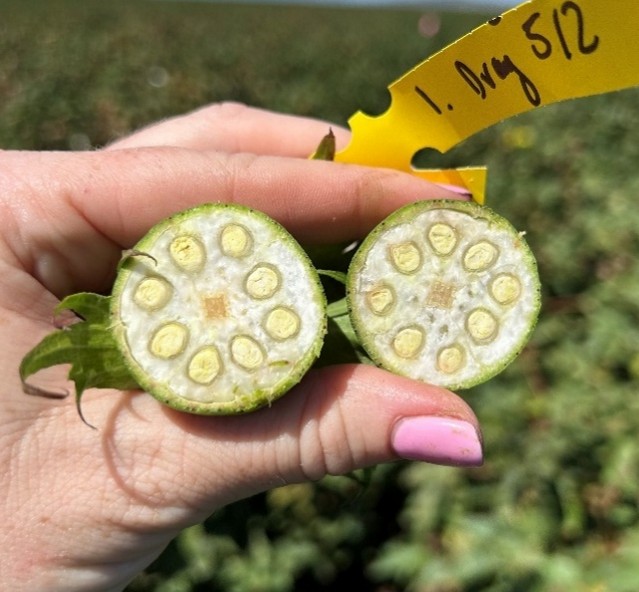
- Assess Crop Maturity: Use the boll cutting technique—cut open bolls to check for seed coat maturity (seed coats turning brown, no jelly inside, see photo below). More than 30% of immature bolls as defined by the boll cutting technique at the time of applying harvest aids may impact quality; although this effect is less if all bolls in a crop have been growing in warm conditions. For futher information read our article Cracking the Code on Boll Maturity
- Balance Boll Development & Weather Risks: As temperatures drop, boll development slows. Late bolls may not mature enough to contribute to yield or quality.
- Avoid Frost Damage: Frost can make defoliants ineffective by damaging the abscission zone. Use LEF dates to reduce late-season frost risk.
- Watch the Weather: Avoid defoliation before rain, as some products can wash off.
- Choose the Right Products: Hormonal defoliants perform best in warmer daytime temperatures >25°C and nights above 12C, while herbicide-based defoliants are more suited to cooler conditions, nights <12°C and/or average temps <18°C.
- Do Not Rush Boll Openers: Applying boll openers or conditioners too early can cause boll shedding, yield loss, and increased neps.
4. Managing Crop Stress Post-Cutout
Keeping stress levels low is crucial for maintaining fibre quality and yield.
- Nutrient Management: Fertiliser is rarely of any use post cutout. Additional fertiliser around cutout can return a plant to vegetative growth and add delays to finishing the crop.
- Pest & Disease Control: Continue monitoring but weigh the cost-effectiveness of late-season insecticide applications.
5. Irrigation Management
Final Irrigation Considerations:
💧 Prevent Moisture Stress: Ensure the crop has enough water to mature existing bolls. Use LEF to plan water budgeting effectively.
💧 Time Your Last Irrigation: Aim to complete boll maturity while leaving the soil profile dry enough for defoliation, limit regrowth and reduce soil compaction at picking. A rule of thumb is to have a full profile at first defoliation, and ideally, ~70% of plant-available water should be extracted during defoliation period.
💧 Avoid Overwatering: Too much water can encourage regrowth, fibre staining, and leaf-grade penalties at harvest.
6. Plant Growth Regulators (PGRs)
Late applications of Mepiquat Chloride (MC) may be needed if excessive vegetative growth continues after cutout. However, unnecessary applications waste resources and do not contribute to yield.
7. Harvest Timing
🚜 Pick on Time: Avoid delays—harvest should begin when conditions are optimal.
🚜 Check Moisture Levels: Do not pick if seed cotton moisture exceeds 12%, as this can impact fibre quality.
🚜 Prioritise Early Harvest: Earlier harvests often result in better lint colour and quality due to lower leaf contamination.
🚜 Field Scheduling: Use crop maturity data to schedule fields for mechanical harvest efficiently.
What Does a High-Yielding Cotton Crop Look Like at Cutout through boll maturity?
To achieve high yields, your cotton crop should exhibit strong plant structure and development at cutout. The CSD Ambassador program has shown over a 10-year period that the following attributes are advantageous:
Plant Structure & Development
🌱 Total Nodes: High-yielding crops typically have 24-25 nodes.
🌱 Fruiting Branches: Around 12-15 effective branches with harvestable bolls.
🌱 Plant Height: Ideal 100-105 cm to support sufficient leaf area.
🌱 Height-to-Node Ratio: growth has ceased with ~5 cm/node evident at cutout.
Fruit Load & Yield Potential
🍃 Boll Numbers: High-yielding crops have 160-180+ bolls per metre at cutout.
🍃 Yield Correlation: Crops producing 12.5 bales/ha or more had around 150+ pickable bolls per metre.
Final Thoughts
A high-yielding cotton crop at cutout is characterised by:
✅ A strong plant structure with ample fruiting branches and nodes.
✅ High boll numbers per metre, supporting excellent yield potential.
✅ Minimal stress throughout the season, ensuring consistent boll development.
✅ A well-timed flowering period to maximise yield opportunities.
By following these key management strategies from cutout to defoliation, you can optimise cotton yield, enhance fibre quality, and improve overall harvest efficiency.