
Natalie Aquilina, Larissa Holland, Chris Teague, and Mick Bange
Key points
- Understanding boll maturity is important as it helps cotton growers and agronomists make more informed decisions about their last effective flower (cutout), which will enable improved defoliation of their crops when the last harvestable boll is properly mature.
- Studies were conducted to examine a new approach to defining boll maturity and last effective flower (LEF).
- The key outcome was to estimate the time in day degrees when bolls reach maturity, which is significantly earlier than estimates previously used. The boll period is traditionally defined as the time it takes from a white flower to develop into an open boll. The revised approach is from a white flower to when a boll has mature fibres (defined using the boll cutting technique).
- Using the traditional definition of boll maturity (boll opening), the boll period is 493 day degree (DD). Using the revised definition, the boll period is 404 DD using the 1532 day degree methodology, which has led to revised recommendations for LEF. These improvements will be incorporated into future versions of the CottonTracka tool.
- These outcomes and the revised understanding of boll maturity will lead to more informed decisions for the effective timing of cutout, which assists in better outcomes for end of season management.
Introduction
For cotton growers, timing is everything. Making timely decisions can be the difference between successful management outcomes or not.
A critical decision crop managers are faced with is when to defoliate their crops. Timely defoliation ensures that leaf is effectively removed, and only mature cotton is opened to optimise fibre quality. Understanding when bolls are properly mature assists with timing this decision.
Another important management decision that is dependent on the understanding of how long it takes bolls to be mature influences the timing of last effective flower (LEF). The timing of the LEF influences cutout timing decisions. Optimal cutout timing ensures the length of the season is exploited to grow bolls but not continue to grow them when they have no chance of maturing. Getting this right also helps to effectively plan a successful harvest aid program before weather conditions deteriorate. Too many immature bolls at the timing of defoliation and boll opening can substantially lower Micronaire and increase neps (fibre entanglements). Traditionally mature bolls, which are identified from cutting bolls, have been based on a very defined and brown seedcoat when cut.
This research refines the definition of the length of boll maturity (in day degrees) and the concept of a revised LEF, based on this revised definition. This new approach focuses on the development of mature cotton fibers within the boll, rather than simply waiting for the boll to develop well defined seed coat in an unopened boll. By understanding and adopting this revised LEF, growers and consultants can make more informed decisions about defoliation and assist in the planning of picking time, especially when coordinating contract pickers, leading to improved yields, enhanced fibre quality, and more efficient resource management.
Premise: Rethinking the Boll Period
A traditional definition of boll period in cotton production focuses on the time it takes for a white flower to develop into an open boll. This period historically has been estimated at 493 Day Degrees (1532 DD). This timeframe has formed the basis for estimating the LEF from climate records, which is the last flower on a cotton plant expected to mature into a harvestable boll.
However, relying solely on an open boll definition to determine defoliation timing has some limitations and potential risks. Waiting for all bolls to open can delay picking, therefore increasing the crops vulnerability to adverse weather conditions such as frost or excessive rainfall, ultimately risking yield and fibre quality.
Research has clearly shown that fibres in a boll can mature well before a boll is open. This research has formed the basis of boll cutting techniques for determining crop maturity. There is evidence to show that fibre in bolls can be mature earlier than generally expected (see Figure 1 and Photo 1) This was supported by studies that have compared the quality of fibres at this stage of development with corresponding fibre qualities of opened bolls taken from the same plants. Figure 2 shows the comparison of fibre qualities of bolls from the two classes and shows that there are little differences between the two classes.
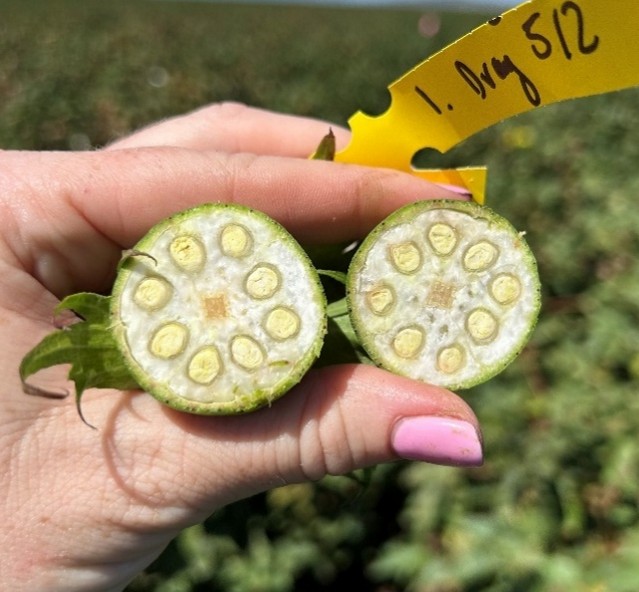
Photo 1. Mature Cut Boll. This boll type was used as the definition of a mature boll in this study.
Figure 1. Seedcoats in mature bolls start to turn brown
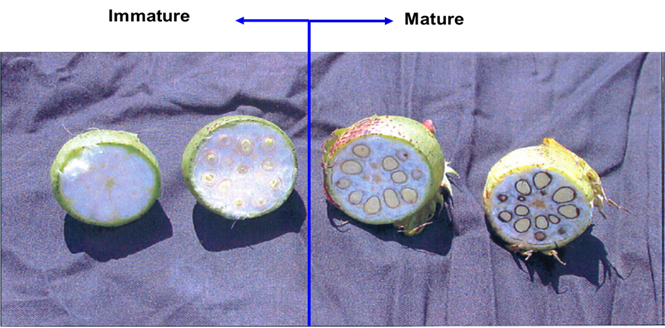
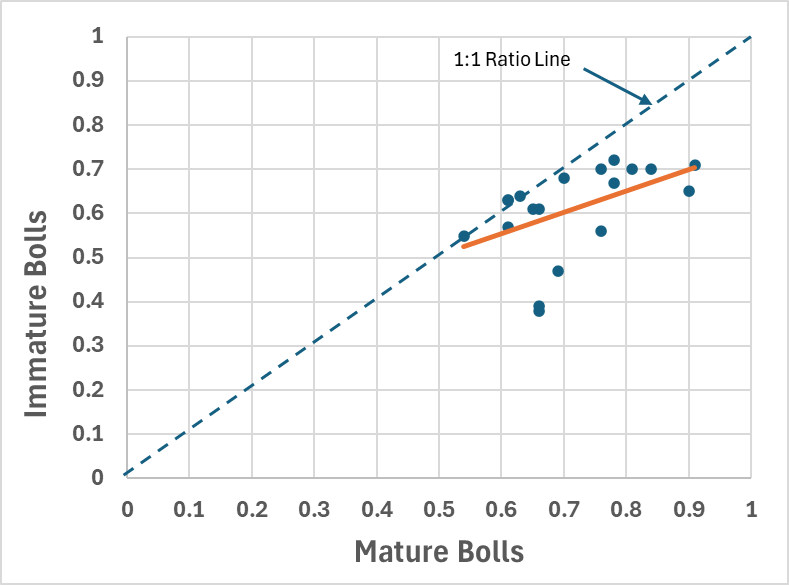
Figure 2. A comparison of fibre maturity ratio (measured using the CSIRO SiroMat) between bolls that have been cut and classified as mature bolls as defined in Figure 1 compared with fibre quality of open bolls taken from the same plants. As data falls along the 1:1 line it means that there are little differences between the classes. In fact, there were instances where the immature bolls had fibres more mature than the bolls previously classified as mature.
Results and Outcomes: Defining the Revised Boll Period
The boll cutting method is a proven way to assess boll maturity, it involves physically cutting bolls open to examine the seed and fibre development. This method was used in the research conducted in the 2023/24 season and played a crucial role in defining boll period using the definition of the boll maturity described above. The aim was to ultimately determine the day degrees that would be required to mature the boll and use this new day degree target to revise the timing of LEF using historical climate data. As per the definition described above, bolls with mature fibre were those that had difficultly cutting with a knife, slightly tan or brown seed coats without gelatinous “jelly”, clearly developed cotyledons and stringy fibers that are moist but not overly watery.
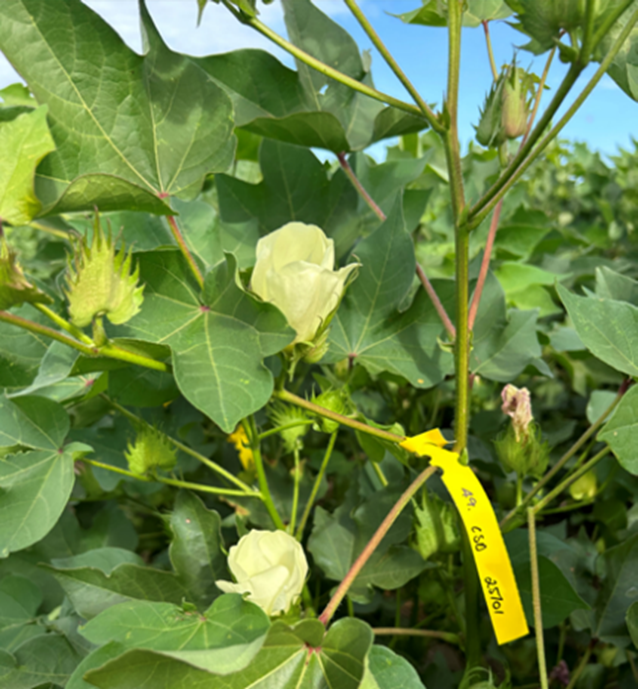
Throughout the season, flowers were tagged at several sites across the Namoi Valley and Darling Downs for close monitoring. First position flowers were tagged on multiple dates from 6 to 2 Nodes Above White Flower (NAWF), recording the date each time (Photo 2). The sites were regularly monitored throughout the season to track the boll maturity.
Photo 2. Tagged White Flowers at trial sites.
To track the progress of bolls we established a boll maturity classification scale from 0 to 6 for assessments (Photo 3). A score of 0 represents a tagged flower and 6 indicates an open boll. In our assessment of bolls with mature fibre, we used a classification of 3.5. While a score of 3 was also considered mature (as per the definition above), we opted for 3.5 to ensure we had some surety built into our assessments in case there were some discrepancies across assessments.
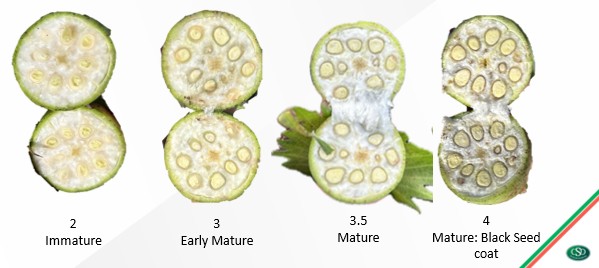
Photo 3: Boll maturity classification scale. Although bolls at classification 3 were considered mature to ensure that there was some buffer in methodology, we classified bolls at 3.5 as those with mature .
We then plotted our maturity scales for each boll we recorded against the day degrees (1532) from when the boll had developed from a white flower. A linear regression was then fitted to this response (Figure 3). When we determine the day degrees for when a boll has mature fibre (at classification 3.5) this equates to 404DD (boll period).
Figure 3: Cumulative day degrees to boll maturity across different classifications. The green dots are bolls monitored in the Namoi while yellow dots are for bolls in the Darling Downs.
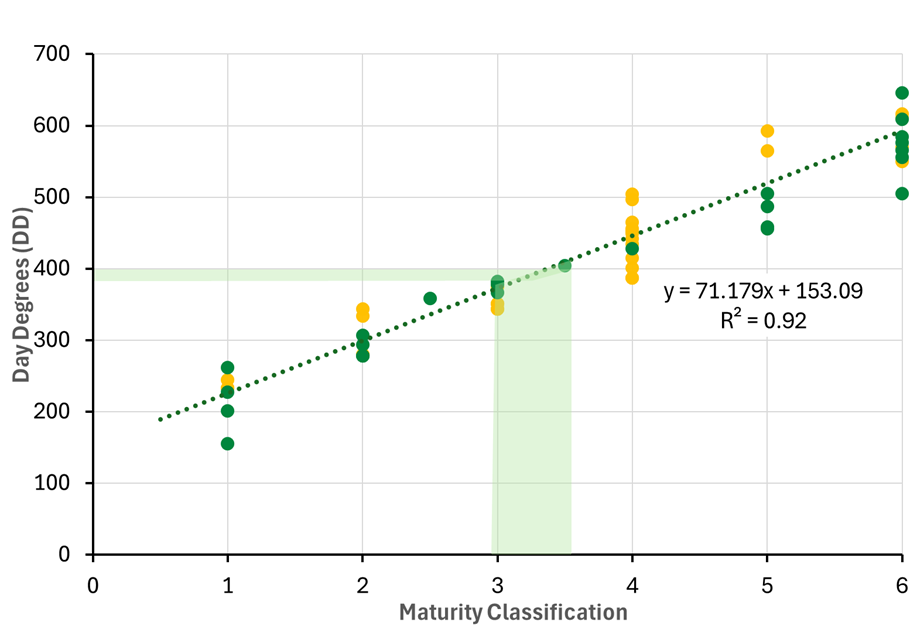
This is a significant reduction from the traditional 493 DD boll period based on boll period for a boll to completely open. The change in day degrees is 89 DD reduction which is a reduction of approximately 20%. This represents a crucial shift in understanding boll development where we can be sure that fibres are mature. It allows for a more precise determination of when cutout can occur to ensure the maturity of the last harvestable boll.
Table 1 shows the revised last effective flower date (LEF)/ cutout dates for various localities. In this assessment the LEF is estimated from a desired time to have a crop defoliated (equals the time of the last harvestable boll). As the date of the desired defoliation date becomes later the cutout date is also later in the season; noting that boll periods are longer because the season cools more the later you go. Some caution is advised here as this assessment does not account for timing of first frost or severe cold weather which may threaten crops as defoliation is delayed.
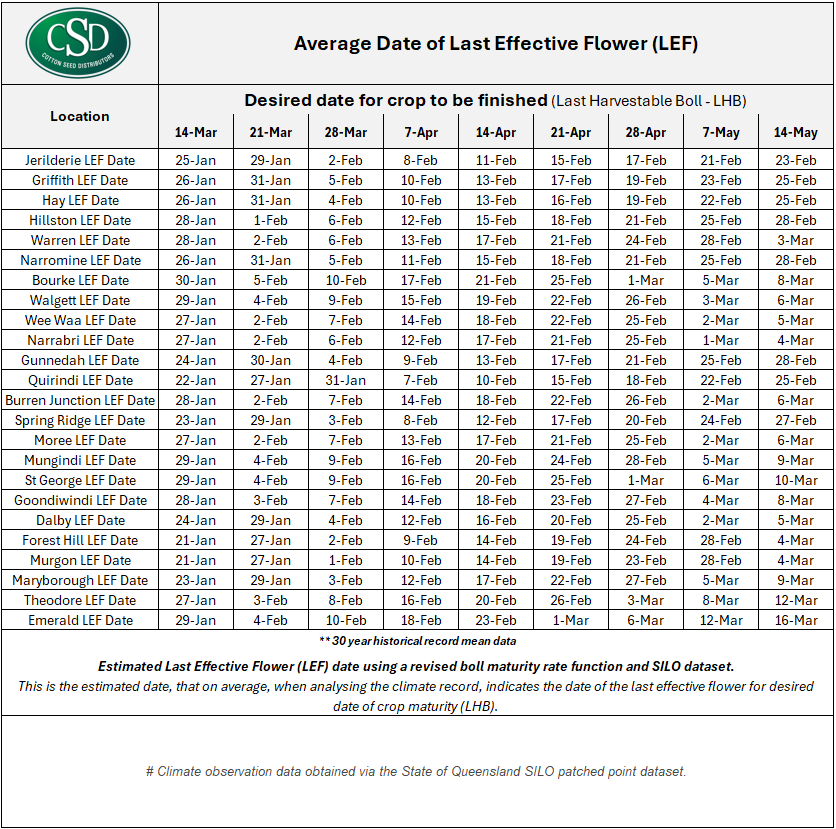
Table 1: Last Effective Flower Analysis using the revised boll period generated in this study
Summary: Cracking the Code for Optimal Cotton Production
Accurately assessing boll maturity is fundamental to optimising defoliation timing and consequently, maximising both yield and fiber quality in cotton production. The research discussed in the sources highlights the benefits of adopting a revised understanding maturity of bolls for estimating crop maturity and a revised understanding of boll period to better estimate timing of cutout.
Making this change (shifting from waiting for bolls to open to recognising that cotton bolls reach maturity earlier than previously thought) offers several benefits for cotton growers.
- Precisely estimate crop maturity resulting in enhanced fibre quality.
- Picking mature bolls (or minimising the inclusion of immature bolls) ensures longer, stronger and more uniform fibres.
- Timely defoliation and picking reduces the risk of weather-related crop damage from frost and heavy rainfall and allows for greater flexibility in harvest planning.
- More precise timing of cutout allows crops to take full advantage of seasonal conditions and can optimise yield and ensure more efficient resource use.
Crop managers are encouraged to embrace this revised approach to estimating LEF. Future versions of CSD’s CottonTracka will enable managers to generate LEF using the new information generated in this study for their fields.